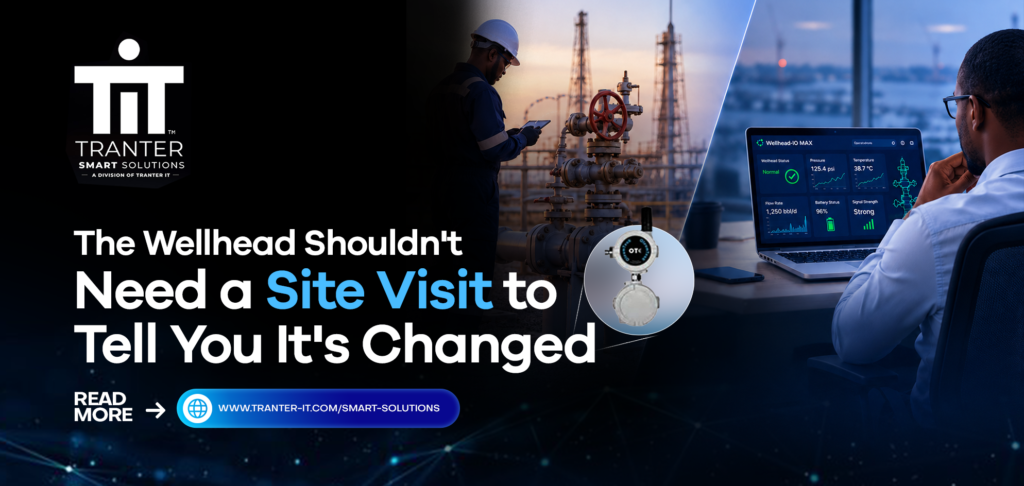
Remote wellhead monitoring gives oil and gas teams a way to see what is happening at the wellhead without waiting for the next site visit.
Consider a typical field operation. An operator travels to a remote well, checks the readings, records the results and reports back to the operations team.
The readings may look normal at 9:00 a.m.
But what happens at 11:00 a.m.?
The wellhead keeps operating. Pressure can change. Flow conditions can shift. A valve may require attention. Yet nobody may see those changes until the next physical inspection.
That creates a visibility problem.
For operators managing remote assets, having access to critical wellhead information from a distance can change how teams monitor assets, prioritise field work and respond to changing conditions.
Why scheduled site visits leave a visibility gap
Physical inspections remain an important part of oil and gas operations. Field teams need to inspect equipment, perform maintenance and handle issues that require physical intervention.
However, not every operational question requires someone to travel to the wellhead.
A question such as “Has the pressure changed?” should not always require a vehicle, a field team and several hours of travel.
Without remote monitoring, however, that can be exactly what happens.
Imagine an operator checks a well in the morning. The readings fall within the expected range, so the operator records them and leaves.
A few hours later, the pressure begins to change.
The operations team may not know about it until someone returns to the site.
Meanwhile, the asset continues operating.
That delay can make it harder to identify changes early. It can also lead to field visits that primarily serve to collect information rather than respond to a known issue.
Remote wellhead monitoring changes what teams can see
The problem is therefore not simply a lack of manpower.
It is a lack of timely information.
When teams can access wellhead data remotely, they can see changes without waiting for the next scheduled inspection.
This approach also reflects a broader shift in oil and gas production monitoring. The Society of Petroleum Engineers’ Journal of Petroleum Technology reported in 2025 that operators are paying greater attention to real-time monitoring, additional sensors and data analytics. The publication also noted that continuous knowledge of production rate and pressure supports field surveillance and production optimisation. SPE Journal of Petroleum Technology: Production Monitoring-2025
The significance is simple.
The more timely the information, the sooner an operations team can investigate a change.
That does not mean every change requires immediate intervention. Instead, teams gain the information needed to decide what deserves attention.
A Nigerian case shows the operational value
There is a useful benchmark from Nigeria.
SLB published a case study on its Lift IQ service deployment with Nigerian Agip Oil Company (NAOC) on remote wells in Nigeria. The service used real-time surveillance and remote control to help manage ESP performance and reduce the need for physical intervention. SLB: Lift IQ service and NAOC Nigeria case study
The reported results are significant.
Over three years, SLB reported an average 33.6% improvement in ESP uptime, while 245 field visits were eliminated. The deployment also eliminated 122.5 days of ESP downtime and enabled approximately 56,200 additional barrels of liquids production at reservoir conditions. SLB: Lift IQ service and NAOC Nigeria case study
These figures relate specifically to the NAOC deployment. They should not be treated as a guaranteed result for every remote monitoring project or as a performance claim for Wellhead-IO MAX.
However, the case demonstrates what remote visibility and intervention can achieve in a Nigerian operating environment.
The lesson is not that every well will deliver the same numbers.
The lesson is that timely field data can help teams make decisions without depending entirely on physical visits.
What should remote wellhead monitoring capture?
Remote wellhead monitoring becomes more useful when it goes beyond one measurement.
Operators may need visibility across several points around the wellhead. Depending on the application, this can include casing, tubing, surface and flowline conditions.
The information also needs to reach the wider monitoring environment used by the operations team.
That is where connected field hardware becomes important.
Rather than collecting readings manually and reviewing them later, connected devices can capture field information and make it available for remote monitoring.
The result is a shift from periodic snapshots to a more continuous view of the asset.
How Wellhead-IO MAX supports remote wellhead monitoring
Wellhead-IO MAX is designed around this connected approach.
The solution can monitor casing, tubing, surface and flowline conditions through analogue inputs. It also supports arrival sensing and valve actuation, giving operators visibility into key wellhead functions while supporting remote control of selected functions. These capabilities come directly from the supplied Wellhead-IO MAX product video script.
The device can also collect data through Modbus and HART and connect that information to a wider monitoring system. This allows wellhead information to become part of the broader operational data environment rather than remaining isolated at the asset.
That distinction matters.
The objective is not simply to install another device at the wellhead.
The objective is to make useful information available to the people who need it.
From readings to decisions
Collecting data is only the first step.
The real value comes from what an operations team can do with it.
Suppose a wellhead begins showing a pressure trend that differs from its normal operating pattern.
With remote access to the data, the team can review the change without immediately sending someone into the field.
- They can examine the available readings.
- They can compare the current condition with previous data.
- They can then decide whether the situation requires further investigation.
If a physical inspection becomes necessary, the field team can go to the site with more information about what they need to investigate.
That changes the purpose of the site visit.
Instead of travelling simply to find out what is happening, the team can travel because the available data indicates that closer attention is required.
Wellhead-IO MAX brings multiple wellhead functions together
Pressure is important, but a wellhead rarely tells its full story through one measurement.
That is why Wellhead-IO MAX supports multiple inputs and functions.
The supplied product script identifies monitoring across casing, tubing, surface and flowline conditions. It also identifies arrival sensing and valve actuation as part of the solution.
This creates a broader picture of wellhead conditions.
For example, an operator may want to understand pressure at different points while also knowing whether a particular event has occurred at the wellhead.
Meanwhile, valve actuation can provide a control capability where the application requires it.
The benefit is therefore not simply more measurements.
It is the ability to bring relevant information and functions into one connected monitoring approach.
Connecting the wellhead to the wider operation
A remote wellhead should not become another isolated source of data.
The information needs to move into the systems that operations teams already use.
Wellhead-IO MAX supports Modbus and HART data collection, allowing critical information to connect with a wider monitoring environment.
This creates an important link between the physical asset and the digital operation.
Data begins at the wellhead.
The monitoring device captures it.
The communication infrastructure moves it.
The monitoring platform presents it.
The operations team then uses that information to make a decision.
That is where remote monitoring becomes useful.
A practical before-and-after scenario
Consider an operator managing several remote wellheads.
Before remote monitoring, field personnel follow a scheduled inspection routine. They travel to each location, collect readings and return the information to the operations team.
Most readings may show normal conditions.
However, a change can occur between two visits.
With remote wellhead monitoring, the team can access relevant measurements without waiting for the next scheduled trip.
If the data remains within the expected range, the team has better visibility into current conditions.
If a reading changes, the team can investigate sooner.
The physical visit still has a role. However, the team now has information before travelling.
That can make the intervention more focused and the decision-making process more informed.
The value is not more data. It is better visibility.
There is a temptation to measure everything simply because modern technology makes it possible.
That is not the point.
A wellhead can generate significant amounts of information. If nobody can interpret or act on that information, collecting more of it does not solve the operational problem.
The better approach is to identify the measurements that matter, capture them reliably and make them accessible to the right people.
Wellhead-IO MAX fits into that approach by bringing multiple wellhead monitoring capabilities together and connecting field data to wider monitoring systems.
The result is a clearer connection between what is happening at the asset and what the operations team knows about it.
Remote wellhead monitoring should support the people in the field
Remote monitoring does not mean removing field teams from the operation.
Quite the opposite.
Field personnel remain essential for inspections, maintenance and physical intervention.
The difference is that remote information can help teams decide where their attention is needed.
A technician does not have to discover every change by physically reaching the asset.
The monitoring system can provide information first.
The team can then determine the appropriate response.
That can support a more proactive operating model, particularly when assets are distributed across remote locations.
The wellhead is already telling you something
Every wellhead produces information.
The challenge is knowing what it is telling you before the next scheduled visit.
Remote wellhead monitoring helps close the gap between the physical asset and the operations team by making critical field information available from a distance.
The NAOC case demonstrates the potential operational value of remote surveillance and intervention in a Nigerian environment. SLB reported a 33.6% average improvement in ESP uptime over three years, 245 eliminated field visits and 122.5 days of eliminated ESP downtime. SLB: Lift IQ service and NAOC Nigeria case study
Those results belong to that specific deployment. They are not a promise of what every remote monitoring project will achieve.
What they do show is the value of giving operations teams timely information and the ability to respond without always depending on a physical visit.
Wellhead-IO MAX provides a connected approach to wellhead monitoring, with support for casing, tubing, surface and flowline measurements, arrival sensing, valve actuation, Modbus and HART data collection.
The goal is not to collect data for the sake of collecting data.
It is to give operations teams better visibility so they can make better decisions.
Because the wellhead does not wait for the next site visit to change.
Your visibility should not have to either.