
Nigeria’s Digital Future Demands Action:
ITGOV 2026
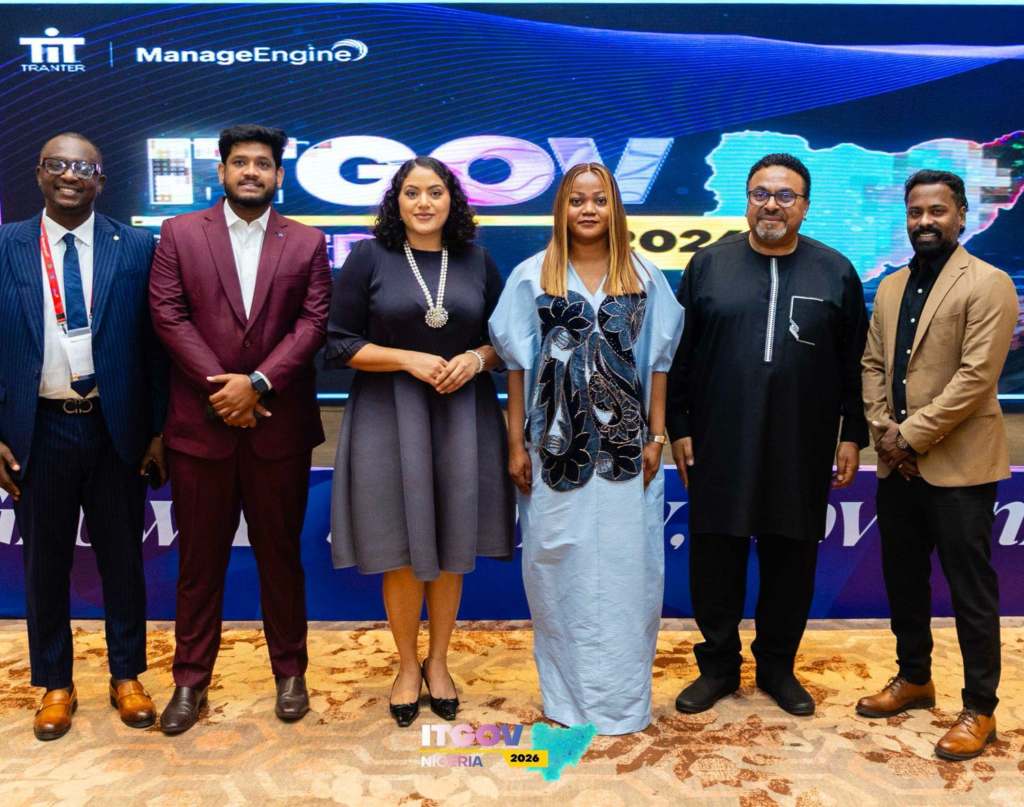
On 16 July 2026, Tranter IT and ManageEngine hosted the third edition of ITGOV, the annual IT Governance Summit in Abuja, bringing together over 450 government officials, technology leaders, and public sector executives under the theme, Building Nigeria’s Digital Public Infrastructure for Economic Growth, Security, and Governance Efficiency.
From the keynote address delivered by the Director-General of the National Identity Management Commission (NIMC) to a high-level panel featuring leaders from government, academia, and industry, ITGOV 2026 made one thing abundantly clear: Nigeria’s digital transformation is no longer a future ambition—it is an urgent national imperative requiring coordinated action across institutions and sectors.
What emerged from the summit was more than conversation. It was a shared commitment to building the digital foundations that will shape Nigeria’s economic competitiveness, governance efficiency, and national security for decades to come.
The growth of ITGOV reflects this growing urgency. While the 2025 edition welcomed 280 delegates, attendance rose to 456 participants in 2026—a 63 percent increase that underscores the expanding recognition that IT governance is no longer solely an IT concern. It is a strategic national priority.
Building the Foundation for Nigeria's Digital Future
The keynote address was delivered by Engr. Abisoye Coker-Odusote, Director-General and Chief Executive Officer of the National Identity Management Commission (NIMC), one of Nigeria’s foremost voices on digital infrastructure and identity management. Her message was clear, urgent, and unambiguous.
Nigeria, she argued, stands at a defining moment in its digital transformation journey. The absence of robust Digital Public Infrastructure (DPI) is not merely a technological challenge—it is a structural vulnerability with far-reaching implications for economic growth, social inclusion, and national security.
Coker-Odusote positioned digital identity as the foundational layer upon which every successful digital economy is built. Trusted digital identity systems are not optional components of modern governance; they are essential enablers of secure transactions, efficient public service delivery, and meaningful financial inclusion. Without them, the promise of Nigeria’s digital economy remains inaccessible to millions of citizens and businesses it is intended to empower.
“Without a professional DPI, governments will continue to struggle to deliver services effectively, financial institutions will face heightened risks, businesses will suffer unnecessary costs, and marginalised businesses may be excluded from the global economy.”
— Engr. Abisoye Coker-Odusote, Director-General, National Identity Management Commission (NIMC)
Her remarks set the tone for everything that followed: a day of discussion grounded not in what Nigeria could one day become, but in what it must urgently do.
The conference was formally opened by Mr. Solomon Raj K, Associate Director at ManageEngine, who welcomed delegates on behalf of the organization and reflected on the significance of ITGOV reaching its third edition. His opening address acknowledged the deepening relationship between ManageEngine, Tranter IT, and Nigeria’s public sector as a relationship built on a shared recognition that the adoption of robust digital solutions for government operations is not a future ambition but a present necessity.
Solomon Raj expressed gratitude for the growing engagement from Nigerian government institutions with ManageEngine’s suite of IT governance and security solutions, noting that the interest and momentum witnessed over three editions of ITGOV reflects a genuine appetite within the Nigerian public sector to modernize, secure, and professionalize its digital operations. His remarks underscored ManageEngine’s long-term commitment to Nigeria as a strategic market, not merely a commercial one.
During the goodwill address which was delivered by Dr. Uche Ifeanyi Henry, Assistant Inspector General of Police, representing the Deputy Inspector General of Police, Dr. Isyaku Mohammed. Dr Henry noted that IT governance conference signals an important shift in how security institutions are engaging with the digital transformation agenda. His address reinforced the message that digital transformation is no longer a conversation taking place only within technology ministries. It is a conversation that now reaches across every arm of government.
The Panel Discussion: Where Policy Met Practice
The day’s most dynamic session was the panel discussion: Driving Digital Transformation in the Public Sector — Opportunities and Challenges. The panel brought together five senior voices spanning government, regulation, academia-industry collaboration, and the private sector. What emerged was not a comfortable consensus, but an honest reckoning with both the opportunities ahead and the structural obstacles that continue to slow Nigeria’s digital progress.
Dr. Engr. Salisu Kaka, Director of e-Government and Digital Economy Development at the National Information Technology Development Agency (NITDA), offered a framework that cut to the heart of why so many digital transformation initiatives stall before they deliver. For Kaka, the challenge is not primarily technological. It is human.
“The three components that lay a strong foundation for digital transformation are people, process and technology. The tools at hand are the people — so we need to empower them, educate them, train them until they can identify the potential in them.”
— Dr. Engr. Salisu Kaka, Director, e-Government & Digital Economy Development, NITDA
This is a point that cannot be overstated. Nigeria has invested significantly in technology acquisition. The constraint, as Kaka observed, lies in the human capital required to deploy, maintain, and derive value from that technology. Without a sustained investment in skills development, digital tools become expensive assets that underperform or go unused.
Mr. Sam Ifeanyi Hart, Chief of Staff to the Office of the Deputy Speaker of the House of Representatives, brought a legislative and policy perspective that added a critical dimension to the discussion. For Hart, the path to a functioning digital economy in Nigeria requires a deliberate structural alignment between three pillars: academia, government, and the private sector that have historically operated in relative isolation from one another.
“The country needs to have the triple helix implementation strategy for the digital economy, where academia is working in collaboration with the government, and the government is collaborating with the private sector — and that way, academia will produce the students who will learn what is required for the upcoming digital economy.”
— Mr. Sam Ifeanyi Hart, Chief of Staff to the Deputy Speaker, House of Representatives
Hart’s triple helix framework is a recognition from within government that Nigeria’s digital economy cannot be delivered by technology companies or government agencies alone, as it requires a new architecture of collaboration that begins in the classroom and connects seamlessly to the corridors of policy and the floor of the market.
The panel also featured contributions from Mr Akintayo Bamisaye, Head of Research and Digital Innovation at GB8, and Mr Abel Edoka, Global Communications Manager at Tranter IT, who collectively reinforced the theme of intentional, coordinated action as the distinguishing factor between countries that are successfully building digital economies and those that are not.
Tranter IT's Commitment: Building for the Long Term
Dr. Lare Ayoola, Chief Executive Officer of Tranter IT and President of the Information Technology Association of Nigeria (ITAN), delivered the conference’s closing remarks and in doing so, articulated a vision that extended well beyond the day’s proceedings.
“Our objective is not simply to deploy technology. Our objective is to build long-term partnerships that strengthen public institutions, improve operational efficiency, and help position Nigeria among the world’s leading digitally enabled economies.”
— Dr. Lare Ayoola, CEO, Tranter IT & President, ITAN
His speech defines precisely how Tranter IT understands its role in Nigeria’s digital transformation journey. Technology deployment, in isolation, is not the goal. The goal is institutional strengthening: building the capacity, the processes, and the governance frameworks within Nigeria’s public institutions that allow technology to deliver its full value sustainably over time.
What Dr. Ayoola described at ITGOV 2026 is a different proposition entirely: not a vendor relationship, but a partnership built on long-term commitment and shared accountability for outcomes.
The Scale of ITGOV 2026: A Conference That Reflects a Movement
The conference attracted coverage from some major print and digital media outlets, including Punch, Vanguard, The Guardian, BusinessDay, This Day, Periscope, and the News Agency of Nigeria as well as prominent television stations: Arise TV, Channels Television, and TVC. The breadth of media representation reflects the growing recognition that IT governance is a mainstream national conversation, not a niche technology sector discussion.
The work, of course, is far from finished. The gaps in digital infrastructure, in human capital, in regulatory frameworks, and in the quality and reach of digital public services remain significant. However, ITGOV 2026 made it clear that the right questions are being asked by the right people in the right room, and that, in itself, represents meaningful progress.
Looking Ahead: ITGOV 2027
ITGOV will return in 2027 with an expanded agenda, a deeper focus on measurable outcomes, and an even stronger commitment to building the bridges between government policy, technology capability, and digital public service delivery that Nigeria needs.
For government institutions, technology leaders, and private sector organizations who are shaping Nigeria’s digital future, ITGOV 2027 is the forum you will not want to miss. Details will be announced in due course.
To learn more about how Tranter IT and ManageEngine are supporting Nigeria’s digital transformation journey, or to begin a conversation about your organisation’s IT governance needs, contact us here
Tranter IT Infrastructure Limited is a leading Nigerian technology solutions company and authorized ManageEngine partner. ITGOV is an annual IT governance summit convened by Tranter IT to drive dialogue between government, industry, and technology leaders on Nigeria’s digital transformation agenda.