
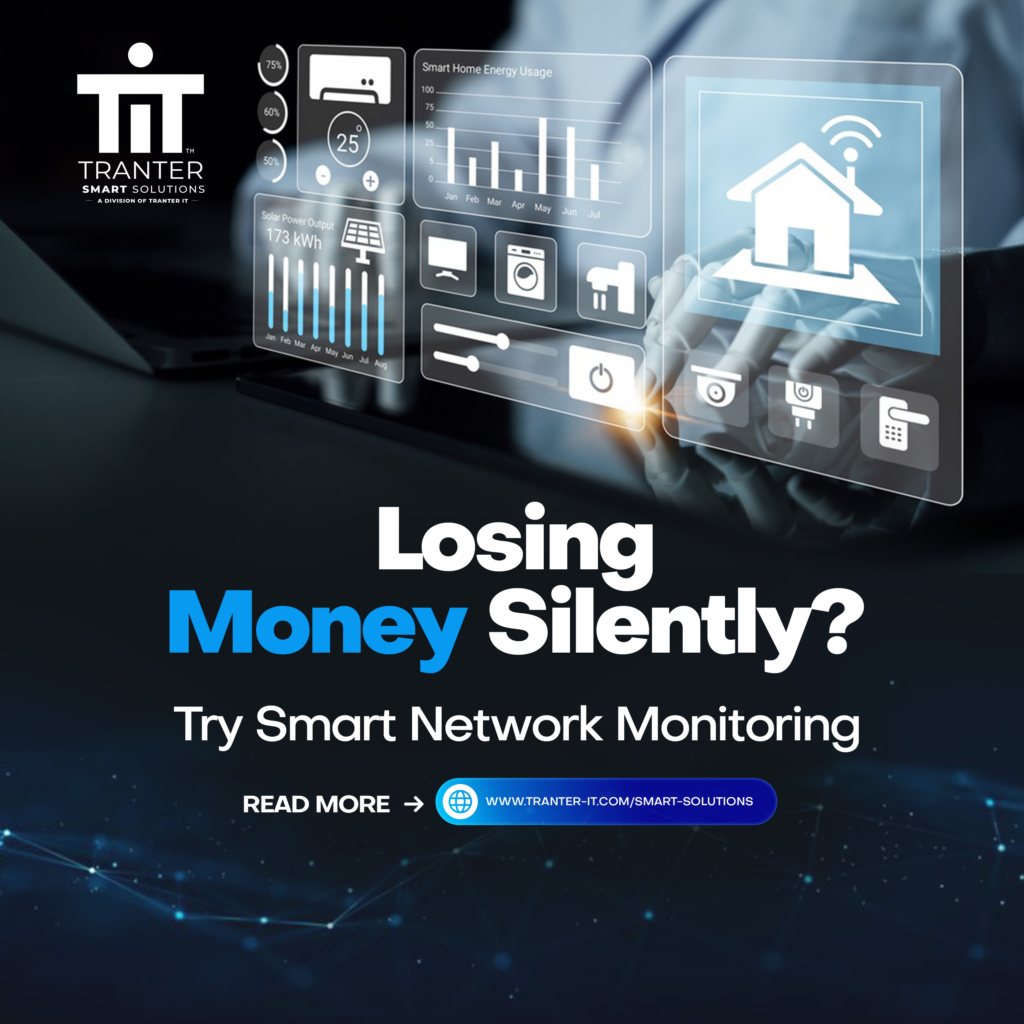
Most businesses are losing money right now and have no idea where. Not through bad decisions or poor management, but through gaps in visibility that smart network monitoring is specifically designed to close. The right information exists inside your operations. It is just not reaching the right people at the right time.
A generator is running two hours longer than necessary. A cold room drifting above temperature for days. A fleet vehicle is taking the long route because nobody thought to check. Individually, these things seem minor. Collectively, they erode output, inflate costs, and quietly undermine reliability.
The gap between where a business is performing and where it could be is rarely about effort. It is about visibility. And that is precisely what smart network monitoring is built to provide.
Where Operational Losses Hide
Most operational losses are not sudden. They are gradual. A compressor running at reduced efficiency for weeks. An asset sitting idle while appearing available on paper. Energy consumption spiking during off-peak hours, unnoticed until the invoice arrives.
The challenge is not that businesses are poorly managed. It is that the information needed to manage them well is not arriving fast enough, or clearly enough. Teams rely on periodic reports, manual checks, and end-of-month reviews to understand what happened, by which point the cost has already been absorbed.
This is particularly acute for businesses operating across multiple sites, running large fleets, or depending on specific environmental conditions to protect their products. The data that could drive better decisions often exists somewhere, it is just not connected, surfaced, or actionable in real time.
You’re Not Underperforming. You’re Under-Informed.
Here is the shift that changes everything: most performance issues are not operational failures. They are visibility failures.
When businesses start treating performance optimisation as a data problem rather than a management problem, the path forward becomes clearer. The question stops being “why aren’t our teams doing better?” and becomes “what information do our teams not have?”
Not acting is a decision in itself. IDC research estimates that unaddressed internal inefficiencies cost businesses between 20% and 30% of annual revenue. That figure rarely appears on any dashboard, which is exactly the problem smart network monitoring solves. What you cannot see, you cannot fix. And what you cannot fix keeps costing you.
The businesses making the most consistent performance gains are not those with the biggest budgets. They are the ones with the clearest, most timely picture of what is happening inside their operations. That is the promise of smart network monitoring: not complexity, but clarity.
What Smart Network Monitoring Actually Does
Smart network monitoring connects physical assets, machines, vehicles, storage units, utility meters, environmental sensors, to a centralised platform that processes and presents data continuously. The result is real-time visibility across every layer of an operation, from a single facility to a distributed network of sites.
Energy monitoring: cut the cost you cannot currently see
Energy is one of the most significant and least transparent operational costs. Monthly invoices tell you what you spent, not where, when, or why. Smart energy monitoring tracks power usage in real time, down to individual machines, zones, or shifts. Standby loads, peak-hour inefficiencies, and equipment drawing excess power all become visible and actionable.
Asset tracking: stop losing money to assets you cannot locate
Unused assets still cost money, in depreciation, insurance, and lost opportunity. Smart asset tracking gives continuous visibility into the location, movement, and utilisation of vehicles, equipment, and inventory. Usage data also enables smarter maintenance scheduling, shifting from fixed calendar intervals to condition-based servicing.
Environmental monitoring: when conditions drift, the damage is already done
In food production, pharmaceuticals, cold chain logistics, and similar sectors, environmental monitoring is non-negotiable. Real-time alerts mean deviations are caught before stock is compromised or regulatory thresholds are breached. Layered sensor coverage across temperature, humidity, CO2, particulate matter, and VOCs gives facilities a complete picture at all times.
Equipment condition monitoring: catch the warning before it becomes the breakdown
Unplanned downtime is costly and disruptive. Equipment condition monitoring tracks vibration, temperature, and power draw to catch early signs of wear, often weeks before a breakdown occurs. Detecting a failing bearing before it seizes is far cheaper than replacing the motor it destroys.
Utility monitoring: every litre, every unit, every naira accounted for
Utility costs often go unnoticed until the bill arrives. Real-time metering tracks water, fuel, and fluid levels continuously, catching anomalies the moment they appear rather than at the end of the billing cycle.
What Smart Network Monitoring Looks Like When It’s Working
The situation: A pharmaceutical distribution company operates three cold storage facilities and manages a fleet of 28 refrigerated delivery vehicles. Energy costs have risen 22% year-on-year, and two temperature excursion events in the past quarter have raised serious product integrity concerns.
BEFORE
- Monthly energy invoices with no site or shift-level breakdown
- Temperature logs checked manually at shift end, with issues found too late to act on
- Vehicle refrigeration assumed to be working unless a driver reports a fault
- Maintenance scheduled by calendar, often too early or too late
AFTER
The following outcomes were delivered using our smart monitoring solution portfolio, including the Adeunis Current Transducer, the Connected Airwits sensor range, the FMB 003 OBD Tracker, and Sens’it.
- Live dashboards show energy consumption by site, zone, and equipment, with faults flagged within 90 minutes
- Continuous temperature monitoring across all storage and vehicles, with instant alerts on any deviation
- Real-time refrigeration data for every vehicle, eliminating reliance on driver-reported faults
- Condition-based servicing removes guesswork from the maintenance schedule entirely
The business did not change its people, its routes, or its processes. It changed what those people could see. And that made every other decision sharper.
Optimising Business Performance Is a Visibility Problem. Here’s the Solution.
Most businesses manage reactively, investigating problems after they happen and making decisions on data that is already weeks old. Smart network monitoring changes that by removing the uncertainty that forces businesses to respond rather than prevent. Small inefficiencies are caught before they compound, and good decisions become the default.
The answer is not more effort. It is smart network monitoring that shows you exactly where the money is going.
Most businesses only discover their biggest inefficiencies after the cost has already been absorbed. A smart network monitoring assessment takes less than an hour and maps exactly where visibility gaps are draining your bottom line.
Stop losing money in silence. Book your smart network monitoring demo today and see your operation clearly for the first time.