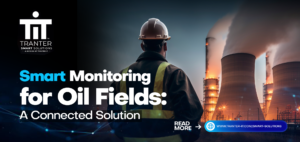
Smart Monitoring for Oil Fields: A Connected Solution
There is a moment every field engineer knows well. A pressure reading looks slightly off on a paper log from three days ago. Nobody noticed at the time, because nobody was watching that exact number at that exact hour.
This is the gap that smart monitoring for oil fields was built to close. By the time the anomaly gets flagged, the well has often already been underperforming for days. Or worse, a valve has failed, and a crew is racing out to a remote wellhead to fix something that could have been caught early.
This is not a story about bad engineers. It is a story about a bad information system. Consequently, it plays out across oil fields every single day.
This is not a story about bad engineers. It is a story about a bad information system. Consequently, it plays out across oil fields every single day.
Smart Monitoring for Oil Fields: Why the Problem Isn't What It Looks Like
Oil and gas is, on paper, one of the most instrumented industries in the world. Wells have gauges. Tanks have level indicators. Flow lines have meters. However, a surprising amount of that data still lives on clipboards or in manual log sheets. Much of it sits inside equipment that nobody checks until a shift change or a scheduled inspection.
The result is a strange paradox. Operators are surrounded by information, but they rarely have it when they need it.
The result is a strange paradox. Operators are surrounded by information, but they rarely have it when they need it. Consider a typical upstream operation with wellheads spread across a remote field. A pressure transmitter might record data every second, yet if the team only checks that reading once a day during a site visit, the company is effectively operating on a 24-hour delay. In an industry where a stuck valve or a leaking tank can escalate quickly, a day is a long time to not know something is wrong.
The costs add up in ways that rarely make it into a boardroom conversation until they become unavoidable. According to Birlasoft’s research on predictive maintenance in oil and gas, the average oil and gas company experiences roughly 27 days of unplanned downtime a year, costing close to 38 million dollars. Even a short, three and a half day disruption can run into millions. That is not a rounding error. It is a structural leak in the business, hiding in plain sight because nobody had visibility into the problem before it became one.
Add in the operational reality of oil fields, remote terrain, harsh weather, offshore platforms, and hazardous zones, and the visibility gap only widens further. Sending a technician to manually check a wellhead pressure reading in a remote desert location is expensive, slow, and sometimes genuinely dangerous.
The Data Paradox
Consider a typical upstream operation with wellheads spread across a remote field. A pressure transmitter might record data every second. Yet if the team only checks that reading once a day during a site visit, the company is effectively operating on a 24-hour delay. In an industry where a stuck valve or a leaking tank can escalate quickly, a day is a long time to not know something is wrong.
The Cost of Not Knowing
The costs add up in ways that rarely make it into a boardroom conversation until they become unavoidable. According to Birlasoft’s research on predictive maintenance in oil and gas, the average oil and gas company experiences roughly 27 days of unplanned downtime a year, costing close to 38 million dollars. Even a short, three and a half day disruption can run into millions. That is not a rounding error. It is a structural leak in the business. It hides in plain sight because nobody had visibility into the problem before it became one.
Remote and Hazardous Terrain Widens the Gap
Add in the operational reality of oil fields, remote terrain, harsh weather, offshore platforms, and hazardous zones, and the visibility gap only widens further. Sending a technician to manually check a wellhead pressure reading in a remote desert location is expensive, slow, and sometimes genuinely dangerous.
The Insight: A Visibility Problem, Not an Energy Problem
Here is the reframe worth sitting with. Most of what gets labeled an “operational efficiency” problem in oil and gas is actually a visibility problem wearing a different name.
Downtime rarely happens because equipment is fundamentally unreliable. Instead, it happens because a failure goes unseen, since nobody was watching closely enough, often enough, from far enough away.
Safety incidents rarely stem from ignorance either. Rather, they happen because a temperature spike or a pressure drop occurs between inspection intervals. That gap is invisible to anyone until it becomes a bigger event.
Once you see the pattern this way, the solution stops looking like “buy better valves” or “hire more inspectors.” Instead, it starts looking like “close the gap between when something happens and when someone knows about it.”
That gap is exactly what smart monitoring for oil fields is designed to close.
How Smart Monitoring Solves the Oil Field Visibility Gap
In practical terms, smart monitoring means placing sensors on the assets that matter most. That includes pressure transmitters on wellheads, thermocouples on flare stacks, level transmitters on storage tanks, and flow totalizers on pipelines. All of it connects to a gateway that pushes real-time data back to a dashboard someone can actually see.
The idea sounds simple because it is simple. Still, the value comes from what that simplicity unlocks across an oil field’s daily operations.
Pressure Monitoring
Instead of a manual pressure check once a shift, a transmitter at the wellhead sends continuous casing and tubing pressure readings straight to a gateway. If a reading drifts outside a safe range, the system triggers an alert. In more advanced setups, it can trigger an automatic response, like shutting a valve, before anyone needs to step in.
Tank Level Monitoring
Storage tanks are easy to overlook until one overflows or runs unexpectedly low. Ultrasonic or resistive level transmitters give a live read on product and interface levels. That matters when a team manages multiple tanks across a site and cannot physically check each one every hour.
Temperature and Flare Stack Monitoring
A thermocouple transmitter on a flare stack does something a scheduled inspection cannot. It watches continuously, so abnormal heat patterns get flagged the moment they start rather than the moment someone happens to walk by.
Flow Monitoring
A flow totalizer transmitter tracks raw volume and rate in real time, giving operators a running picture of throughput instead of a once-a-day snapshot.
Asset and Personnel Tracking
In remote or hazardous sites, GPS-enabled panic buttons and asset trackers add a layer of protection that manual check-ins cannot match. These devices send geofencing alerts, movement alerts, and low battery warnings automatically. Nothing depends on someone remembering to check in.
None of this replaces the people running the field. Rather, it replaces the guesswork they used to operate with.
Smart Monitoring in Action: Before and After
Picture a mid-sized operator running a cluster of wellheads across a remote field. It’s the kind of setup where a single site visit can take half a day just in travel time.
Before smart monitoring: the team logs pressure and temperature readings manually during scheduled rounds. A slow pressure drift on one wellhead goes unnoticed for two days. By the time anyone catches it, output has already dropped, and the eventual fix requires an emergency callout.
After smart monitoring: the same wellhead sends live pressure data to a gateway, which flags the drift within minutes of it starting. An engineer reviews the dashboard remotely, decides it only needs a minor valve adjustment, and resolves it without ever needing an emergency site visit.
The difference is not a new well or a bigger budget. Rather, it comes from closing a visibility gap that used to cost days, and sometimes production, every single time.
The Takeaway: Smart Monitoring for Oil Fields Changes What Operators See
Smart monitoring for oil fields is not about adding more technology for its own sake. It is about giving people the information they were always supposed to have, at the moment they actually need it, rather than after the fact.
The oil field of the future will not necessarily have more equipment than the one operating today. It will simply have equipment that talks, continuously and in real time, to the people responsible for keeping it running safely and efficiently.
Ready to Close the Visibility Gap in Your Field?
If any part of this sounds familiar, a wellhead nobody checks often enough, a tank that runs on guesswork, a site that only gets a full picture once a day, then the fix likely has less to do with new equipment and more to do with new visibility.
Our team has deployed smart monitoring across wellheads, flow stations, and storage tanks in some of the most demanding oil fields in the region, and we can help map out where the biggest visibility gaps are in your own operation.
Book a demo or call +234 708 355 7478