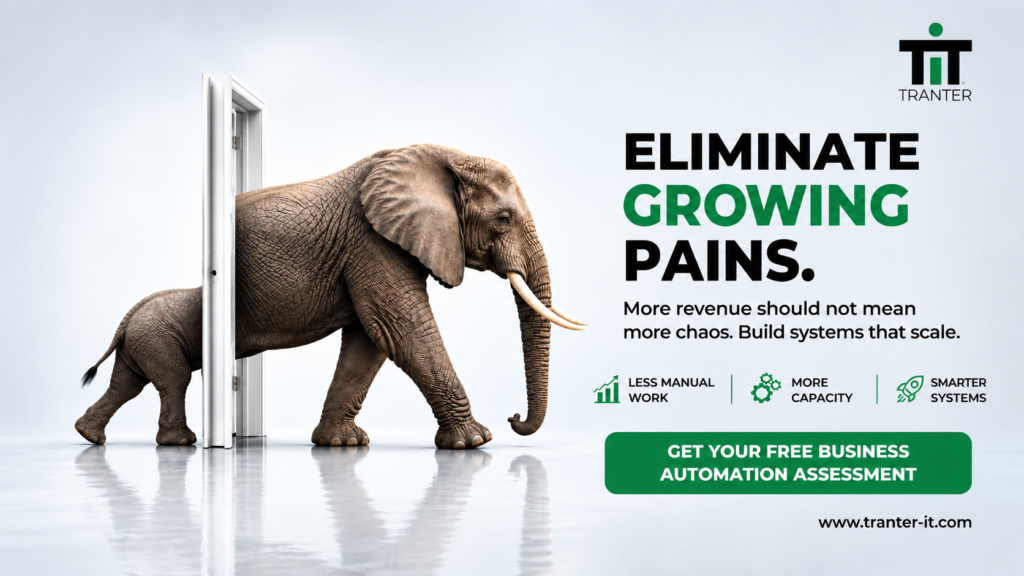
For many business owners, growth sounds simple: get more customers, increase revenue, and build a bigger team.
But growth can quickly create a new problem.
More customers mean more follow-ups. More sales mean more orders to manage. More employees mean more coordination. More activity means more decisions for the business owner.
At some point, the business can become so dependent on manual work and key individuals that growth starts to feel like a burden rather than an opportunity.
This was one of the key themes explored during Tranter IT’s Business Growth Webinar, which brought together business leaders and technology professionals to discuss how businesses can use better processes, systems, and automation to create capacity and scale more effectively.
The webinar featured practical discussions on business bottlenecks, process improvement, documentation, customer follow-up, CRM, and technology solutions such as Zoho.
Growth Is Not the Same as Scaling
One of the most important distinctions discussed during the webinar was the difference between growing and scaling a business.
Growth often means generating more revenue while also taking on more work.
Scaling is different.
A scalable business is able to increase revenue and serve more customers without increasing its workload at the same rate.
For example, if a business doubles its customers but also needs twice as many people, twice as much manual work, and twice as much management time, it has grown—but it may not have truly scaled.
The goal is to create systems that allow the business to handle increasing demand without placing all the additional pressure on the business owner and their team.
The Hidden Bottlenecks Holding Businesses Back
During the interactive session led by Ashley Barrett, participants were encouraged to look closely at their daily activities and identify where their businesses depend too heavily on specific people.
A simple question can reveal a lot:
“What would stop working if I wasn’t available tomorrow?”
Perhaps customer transactions require the owner’s approval.
Maybe social media posts cannot go live without one person’s approval.
Perhaps every new lead has to be manually followed up.
Or maybe customers have to contact one particular employee to get updates about their orders.
These dependencies can become bottlenecks.
They also create single points of failure. When too much knowledge, authority, or responsibility sits with one person, the business becomes harder to manage and more difficult to scale.
Create Capacity Before Adding More Work
When businesses become overwhelmed, the first response is often to hire more people.
But hiring is not always the first solution.
The webinar introduced three practical ways businesses can create capacity:
1. Eliminate unnecessary work
Some activities exist simply because they have always been done that way.
Before trying to improve a process, ask whether the process is necessary in the first place.
Removing unnecessary activities creates immediate capacity without requiring additional employees or technology.
2. Simplify the process
If a task is necessary, look for ways to reduce the number of steps involved.
A complicated process increases the chances of delays, mistakes, and inconsistency.
Simplifying the process can make work easier for both employees and customers.
3. Systematize the work
Once a process is necessary and reasonably simple, it can be turned into a repeatable system.
Documentation, checklists, standard procedures, templates, and technology can help ensure that important tasks are completed consistently—even when the usual person is unavailable.
Document Before You Automate
A major lesson from the webinar was that automation should not be the first step.
Businesses need to understand their processes before introducing technology.
If a process is unclear, inconsistent, or inefficient, automating it may simply make a bad process happen faster.
Before automating a task, businesses should ask:
• What exactly happened today?
• Who is responsible for each step?
• Where are the delays?
• Which steps are repetitive?
• Which decisions require human judgment?
• What information is needed?
• What can be standardized?
• What can technology handle?
Once the process is clearly understood and documented, the business can determine which parts should be eliminated, delegated, systemized, or automated.
From Lead Generation to Customer Follow-Up
One area where automation can make an immediate difference is customer and lead management.
During the webinar, participants identified activities such as client follow-ups and invoicing as areas where businesses would benefit from greater automation.
These tasks may appear small individually, but they become significant as the number of customers increases.
Imagine managing ten customers manually.
Now imagine managing 150.
The same approach that worked for ten customers may become difficult, expensive, and unreliable at 150.
This is where CRM and marketing automation systems can help.
During the live demonstration, Tunde Ajibade, our Zoho expert from Nigeria showed how Zoho can support processes such as:
• Automatically capturing and assigning leads
• Following up with prospects
• Sending scheduled emails
• Nurturing leads over time
• Tracking customer interactions
• Connecting customer communication channels
• Reducing the need for manual follow-up
Instead of relying on memory or spreadsheets to remember who needs a follow-up, businesses can build systems that help ensure opportunities are not forgotten.
Automation Should Not Remove the Human Touch
One important discussion during the webinar was the relationship between automation and human interaction.
Technology can handle repetitive and predictable tasks, but not every customer interaction should be automated.
Customers still want to feel heard.
They want to speak to someone when they have a complex problem. They want businesses to understand their specific needs. They want relationships—not just automated messages.
The answer is not to choose between technology and people.
The opportunity is to use technology to give people more time to focus on the things that require people.
For example, an automated system might send a follow-up email after a customer makes an enquiry. But when that customer has a complex concern, a member of the team can step in and provide personal support.
Automation handles the predictable.
People handle the personal, complex, and strategic.
Five Questions Every Business Owner Should Ask
The webinar introduced a practical way to think about the work happening inside a business.
For every recurring activity, ask whether it should be:
Systemized – Is this repetitive work that can follow a defined process?
Delegated – Does someone else have the skills to handle this effectively?
Automated – Is the task predictable enough for technology to handle?
Eliminated – Does this activity need to happen at all?
Kept human – Does this task require judgment, creativity, relationships, or a personal touch?
This framework can help business owners stop treating every task as something they personally need to manage.
The Real Goal: More Capacity for Growth
The purpose of automation is not simply to use more technology.
It is to create more capacity.
When repetitive tasks are handled more efficiently, business owners and employees can spend more time on activities that create greater value such as building relationships, developing new products, winning new business, solving complex customer problems, and making strategic decisions.
That is what makes automation a business strategy rather than simply an IT project.
Start Small, Then Build
Businesses do not need to transform every process at once.
A better approach is to identify one recurring activity that consumes time and examine it carefully.
Ask:
What are we doing manually today?
Why are we doing it this way?
How much time does it consume?
What happens when someone forgets to do it?
What does it cost the business to continue doing it manually?
Could part or all of the process be handled by a system?
The answers can reveal opportunities for improvement.
Starting with one process can also make it easier to measure the impact of change before expanding automation across other areas of the business.
Building Businesses That Can Work Without Constant Owner Intervention
A growing business should not require its owner to be involved in every decision, every customer follow-up, and every routine task.
The goal is not to make the owner less important.
It is to free the owner to focus on the areas where their experience, leadership, and judgment create the most value.
As businesses grow, the ability to build clear processes and use the right technology becomes increasingly important.
Sustainable growth requires more than getting more customers. It requires building a business capable of serving those customers efficiently.
That means understanding your processes, documenting what works, removing unnecessary steps, delegating where appropriate, and using technology to handle predictable and repetitive work.
When these elements come together, businesses can create the capacity they need to grow—without allowing growth to become another source of pressure.
Ready to Find Your Automation Opportunities?
If you are a business owner wondering where to start, a simple assessment of your current processes can reveal opportunities to save time, improve consistency, and reduce manual work.
Tranter IT offers a free Business Automation Assessment designed to help businesses identify processes that could benefit from better systems and technology.
Book a free Assessment: https://tranter-it.com/book-a-meeting/
Start by looking at one recurring activity in your business today.
The question is not simply, “Can we automate this?”
The better question is:
“How can we build a better way of doing this?”
That is where smarter growth begins.