The short answer
Choose a partner when Zoho will run your sales and follow-up across several people, you have no one with the time or skills to build it, and a failure would cost you real revenue.
Choose in-house when Zoho is a long-term core function, you have a person with real capacity to own it, and there is enough ongoing work to keep them busy.
Choose both when you want speed now and ownership later. A partner builds and trains, and an internal owner runs it day to day. For many 10 to 50 person businesses, this is the strongest setup.
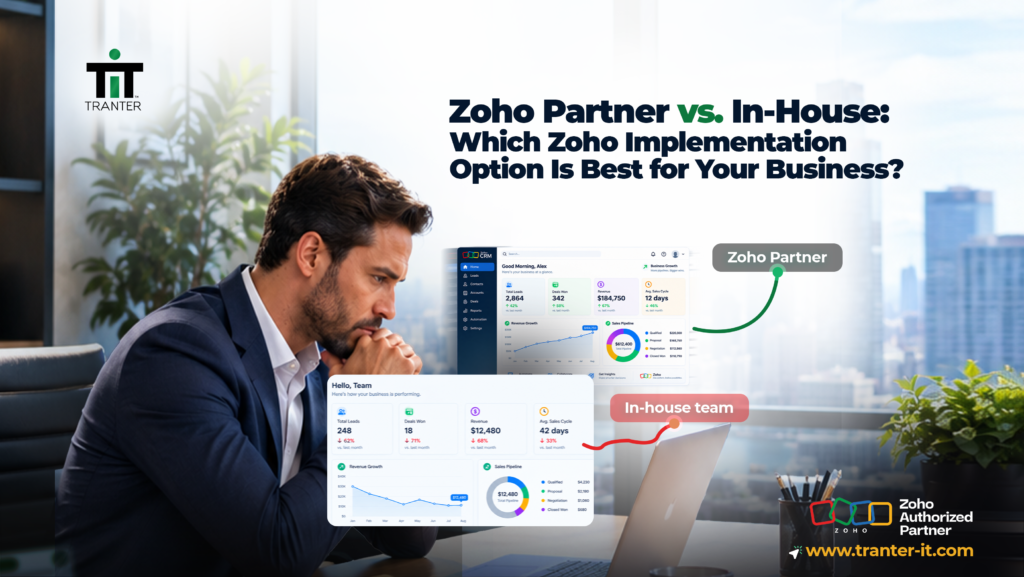
Choosing between a Zoho implementation partner and an in-house build is one of the first big decisions in any Zoho project, and it is easy to treat it as a price question. It is not. We implement Zoho for a living, so we see both outcomes: teams that tried in-house and called us to untangle it, and teams that brought in a partner and now run their system confidently on their own.
Option 1: A Zoho implementation partner
A partner is a firm of Zoho-certified consultants who scope, configure, migrate data, train your team and support you after launch.
Where it wins
Continuity. You get a team, so one person leaving or going on leave doesn’t stall the project.
Process. Discovery, build, testing, training and handover follow a repeatable structure.
Experience. Consultants have seen similar businesses, so you avoid common mistakes in CRM setup, data migration and automation.
Support after go-live. Someone is accountable when something breaks.
Where to be careful
Upfront cost is usually higher than hiring one internal person or doing it yourself.
Quality varies. Some firms sell licenses well and implement poorly.
Ask who will actually do the work, not just who is on the sales call.
A partner learns your business over the project, but never knows it as deeply as your own team.
Option 2: In-house
This means giving the job to an existing operations or admin lead, or hiring someone with Zoho skills.
Where it wins
Knows your business. They understand your customers, your team and your exceptions.
Always available. Small changes happen the same day.
Long-term ownership. The knowledge stays in your company.
Where to be careful
Time to start. Hiring someone with Zoho skills takes time, and an existing employee still has a day job.
Single point of failure. One person holds the knowledge. If they leave, you can be back to square one.
Narrow experience. One person has seen your setup, not dozens of others.
Workload. The role needs enough ongoing work to justify the time or the salary, and builds often stall when other tasks take over.
Side by side
These are general tendencies, not rules.
Factor | Partner | In-house |
Upfront cost | Higher project fee | Salary or staff time |
Speed to a working system | Faster, with a defined plan | Slower while skills are built |
Range of skills | A team across CRM, automation, integrations | Usually one person |
If someone leaves | Others step in | Knowledge can leave with them |
Knowledge of your business | Builds over the project | Strongest |
Day-to-day changes | Via support or a request | Immediate |
Accountability | Contracted scope and support | Depends on one person’s capacity |
Best fit | Building and launching the system | Running and improving it |
Zoho implementation is three jobs, not one
• Design. Deciding how your sales process should work: what counts as a lead, how it is routed and who owns it, what each deal stage means and what you need to report on.
• Build. Configuring Zoho CRM modules, fields and layouts, setting up automation (workflows, Blueprints and custom functions), connecting apps such as Zoho Forms, Bookings, Desk or Books, migrating and cleaning data, and setting user roles and permissions.
• Own. Running it after launch: administration, training new hires, fixing what breaks and adapting as the business grows.
In our experience, disappointing rollouts are usually designed badly rather than built badly, and abandoned ones were never properly owned. That tells you where outside help matters most (design) and where inside ownership matters most (running it).
Why a Zoho implementation partner is usually the easier road
You get a team, not a single point of failure. Projects keep moving when someone is sick, on holiday or gone. Your system does not depend on one person’s calendar.
You skip the expensive mistakes. A partner has set up many sales processes and knows the traps: copying spreadsheet columns into the CRM, automating a process that was already broken, skipping the lead-routing rules that protect revenue.
It is usually faster. A defined plan, tested builds and experienced hands tend to get you to a working system sooner than a side project that competes with a day job.
It takes the weight off you. Data migration, integrations and testing are exactly the jobs that eat an owner’s evenings. A partner carries them, and someone is accountable when something needs fixing.
You still end up in control. A good partner builds with your people and hands everything over, so you are never held hostage.
What a good Zoho partner does differently
A good partner will:
• start with your sales process, not a list of features
• put you in the room, so your admin learns as the system is built
• document every field, stage and automation in plain language
• make sure you own your Zoho organization with full admin rights from day one
• train your team before launch, not after
• stay available afterward, and check in at 30, 60 and 90 days
What drives cost, and what a mistake costs
Ask any partner what drives their quote. It is usually the number of users, the Zoho apps involved, the volume and condition of your data, the integrations, how much custom automation you need and how much training your team requires. One app with clean data costs less and moves faster than a multi-app rollout with years of messy spreadsheets, whoever does the work.
A partner costs more upfront than doing it yourself, and the quality of partners varies. Weigh that against what a mistake costs. In the best-known study of lead response, by Dr. James Oldroyd and InsideSales.com, the odds of qualifying a lead were 21 times higher when the first contact attempt came within 5 minutes rather than 30. A separate Harvard Business Review analysis of 2,241 US companies found an average first response time of 42 hours. The studies are older and covered web leads at a limited set of companies, so treat the exact figures as indicative. The direction is hard to argue with: slow follow-up is expensive, and a poorly designed system is where slow follow-up hides.
Our recommendation
For most businesses with 10 to 50 staff, the best model is the simplest: a partner designs, builds and trains, and you own it from there. Keep a light support arrangement for the heavier changes. You get outside experience where it matters most and inside ownership where it matters most. If your team grows into a full in-house Zoho function, that is a success, not a failure.
Five questions to help you decide
How much revenue depends on this system? The more it touches leads and sales, the more you want experience on your side.
Which Zoho apps will you use in the next 12 months? One app is a very different job from CRM plus Forms, Bookings, Desk and Books working together.
Who will be your admin in 12 months, and do they have protected time? If you cannot name them, plan for training from day one.
Is the hard part design or build? If your team has not yet agreed on lead stages and handoffs, get design help first.
What happens if the person who built it leaves? If the answer is “we start again”, add a second pair of hands.
Frequently asked questions
How much does a Zoho implementation cost?
There is no single price, because it depends on the number of users, the apps involved, your data, the integrations and the amount of custom automation. Ask for a scoped quote that lists what is included, and be wary of a price given before anyone has looked at your process.
How long does a Zoho implementation take?
A focused CRM setup is usually measured in weeks, while a multi-app rollout with data migration takes longer. A good partner will give you a plan with dates before you start.
Can I implement Zoho myself?
Yes, for a simple setup, and many businesses do. The risks are copying your old spreadsheet into the new system, building automation nobody else understands and letting administration slip. If you go it alone, write down your process first and document as you build.
What does a Zoho implementation partner actually do?
They help you design your process in Zoho, build and test the configuration, migrate and clean your data, connect your other tools, train your team and support you after launch.
Should we bring in a partner if we already have Zoho and it is not working?
Often, yes. A review of the design and ownership usually fixes more than a full rebuild, and it is much cheaper than starting again.
About Tranter IT
Founded in 2004, Tranter has grown into a technology partner with over 355 professionals, including more than 264 ICT specialists and smart solution engineers. Our work spans IT infrastructure, business systems integration and Zoho implementation. [Add Zoho partner tier and certifications here.]
Thinking about Zoho?
If you are weighing up Zoho, or have it and it is not pulling its weight, we would be glad to talk it through, with no pressure and no obligation. Tell us how you sell today and we will tell you honestly what we would do, even if the answer is “do it yourself.”