
For a startup, the best software is not the one with the most features. It is the one that turns time, leads, and cash into measurable growth as quickly as possible. Zoho’s suite is attractive for this reason, because its apps are built to work together and cover customer relationships, finance, projects, marketing, support, human resources, and collaboration in one system.
This guide ranks the apps that most startups should adopt first, followed by those that become valuable as the team and customer base grow.
1. Zoho CRM: Highest Return for Revenue
Best for: Founders who sell to leads, manage a pipeline, and want to close more deals.
Zoho CRM ranks first because it affects revenue directly. Instead of leads living in inboxes, spreadsheets, and WhatsApp chats, a CRM centralizes contacts, deals, follow ups, tasks, and sales activity. It also supports lead capture, automation, reporting, and forecasting, which helps a small team focus on the right opportunities.
The evidence is encouraging but should be read with care. Nucleus Research, which reviews published case studies, found in 2014 that CRM returned an average of $8.71 for every dollar spent, up from $5.60 in 2011. Its 2024 review of case studies from 2023 put the average at $3.10 per dollar, a fall of 37 percent over ten years. A return of more than three times the spend is still strong, but the decline suggests that a startup should plan for a solid result rather than a spectacular one. Nucleus has also reported that giving salespeople easy access to customer data shortens sales cycles by 8 to 14 percent.
The return is high for four reasons. A CRM reduces lost leads and forgotten follow ups. It makes the sales process visible, repeatable, and easy to teach. It helps founders see which channels and deals actually convert. It also scales from a simple pipeline to advanced automation as revenue grows.
Start here if: Your startup has customers, prospects, or a sales process. Even a lightweight setup that the team uses every day will outperform scattered notes and email threads.
2. Zoho Books: Protects Cash Flow
Best for: Invoicing, expenses, accounting, tax readiness, and financial visibility.
Zoho Books is arguably the most essential operational app after CRM. Startups often fail not because they lack customers, but because they lose control of cash flow, late invoices, expenses, and compliance. Books helps founders send professional invoices, track payments, manage expenses, reconcile bank transactions, and keep clearer records.
The data shows why this matters. In CB Insights’ study of failed startups, 38 percent said they ran out of cash or failed to raise new capital, which made it the most common stated cause alongside the 35 percent who found no market need. CB Insights’ founder has argued that running out of cash is often a symptom of an earlier problem rather than the root cause, which is a good reason to see problems early. A widely quoted U.S. Bank study goes further and reports that 82 percent of small business failures involve cash flow problems, although that figure is older and is best treated as a rough indicator.
Late payment is a large part of the problem. A 2025 QuickBooks survey of 2,487 small businesses in the United States found that 56 percent had unpaid invoices, with an average of $17,500 owed to each affected business. A 2026 QuickBooks report found that 51 percent of businesses with overdue invoices called cash flow a problem, compared with 36 percent of those without overdue invoices. Xero’s data for the second quarter of 2026 showed that small businesses waited an average of 29.3 days to be paid, with payments arriving almost nine days late.
The return is high for four reasons. Faster invoicing improves the chance of being paid on time. Expense tracking exposes unnecessary spending early. Clean financial records reduce accountant and audit stress. Real time reporting supports better decisions about pricing, hiring, and investment.
Start here if: You are billing clients, collecting payments, hiring, or preparing for funding.
3. Zoho Projects: Turns Plans Into Delivery
Best for: Agencies, product teams, consultants, and any startup that manages deadlines or client work.
Zoho Projects becomes high value once a startup has multiple people, clients, or recurring deliverables. It gives teams a shared place for projects, tasks, milestones, time tracking, and accountability. For service businesses, it can also show whether a project was profitable after accounting for the time the team spent on it.
The cost of weak project delivery is well documented. The Project Management Institute’s 2018 Pulse of the Profession survey found that organizations waste an average of 9.9 percent of every dollar invested in projects because of poor performance, which is $99 million for every $1 billion. It also found that 31 percent of projects do not meet their goals, 43 percent finish over budget, 48 percent finish late, and 52 percent suffer scope creep. Earlier PMI research found that high performing organizations see 90 percent of their projects meet original goals, compared with 34 percent for low performers. These surveys cover mostly large organizations and are not recent, so they show the direction of the problem rather than the exact size of the gain for a small team.
The return is high for four reasons. It prevents missed deadlines and unclear ownership. It reduces the time spent chasing status updates. It makes workload and bottlenecks visible. It helps service startups price and scope work more accurately.
Start here if: Your team regularly asks, “Who is handling this?” or “When will this be done?”
4. Zoho Desk: Retains the Customers You Win
Best for: Startups with recurring customers, software users, online buyers, or growing support requests.
Zoho Desk may not be the first app every founder installs, but its value rises quickly once customer questions exceed what email can handle. It organizes customer requests into tickets, assigns ownership, tracks response times, and creates a searchable record of customer issues.
The cost of poor service is substantial. Zendesk’s 2025 customer experience report found that 63 percent of consumers are willing to switch to a competitor after a single bad experience. Qualtrics reported in late 2025 that consumers reduce or stop spending after 51 percent of negative experiences, and it estimated that U.S. businesses risk $856 billion in revenue each year as a result. PwC’s 2025 survey of 5,511 consumers found that 29 percent had stopped using or buying from a brand because of a poor customer experience. Retention also pays: research by Fred Reichheld of Bain and Company, quoted widely, found that a 5 percent increase in customer retention can raise profits by 25 to 95 percent. That range is wide because it depends on the industry and the economics of each business, and the original work is decades old, but the direction is consistent across later studies.
The return is high for four reasons. Faster support improves retention and referrals. Nothing important disappears in a shared inbox. Common issues can be resolved through self service articles. Support data reveals product gaps and churn risks.
Start here if: You have paying customers who need help after purchase.
5. Zoho Campaigns: Makes Marketing Repeatable
Best for: Lead nurturing, newsletters, product updates, promotions, and re-engagement.
Zoho Campaigns delivers strong results when it is connected to the CRM and used to nurture leads rather than to send random blasts. Startups can segment audiences, automate email sequences, measure opens and clicks, and bring engaged prospects back into the sales pipeline.
Email has the strongest reported return of any common marketing channel. Litmus’s 2025 State of Email report, along with other industry benchmarks, puts the average at about $36 for every $1 spent, and other sources report a range of $36 to $42. The figure varies by sector, with roughly $45 per dollar for retail and consumer goods, $42 for marketing and advertising agencies, and $36 for software and technology companies. Smaller companies are not at a disadvantage in these surveys: companies with fewer than 100 employees averaged $38 per dollar. Two cautions apply. These numbers are self reported by marketers and likely lean toward businesses that track results, and 21 percent of marketing leaders in the Litmus survey did not measure email return at all. Returns also depend on discipline, because results are better when sending is targeted and automated rather than frequent and generic. In the Litmus data, automated emails produced 37 percent of email generated sales from only 2 percent of email volume.
The return is high for four reasons. Email remains one of the most cost efficient ways to nurture demand. Automation keeps prospects warm without manual effort. Campaign data shows which messages generate interest. It strengthens both new lead conversion and existing customer retention.
Start here if: You have a lead list, trial users, or customers who should hear from you regularly.
6. Zoho People: Essential as the Team Grows
Best for: Startups that hire employees and need to manage leave, onboarding, performance, and human resources records.
Zoho People usually becomes valuable once informal human resources processes start breaking down. It helps centralize employee information, leave requests, onboarding, attendance, and performance conversations. For a small team it may not be urgent, but for a growing startup it prevents administrative chaos.
Onboarding is the clearest place to see the payoff. Research by the Brandon Hall Group, widely cited, found that organizations with a strong onboarding process improve new hire retention by 82 percent and productivity by more than 70 percent. A separate figure from the Society for Human Resource Management, as commonly quoted, is that a standard onboarding process makes new hires about 50 percent more productive. One frequently repeated survey also found that only 12 percent of U.S. employees believe their employer onboards well. These figures come from consulting and trade research rather than controlled studies, so the precise percentages should be treated as indicative. The central point holds: a consistent first few weeks is a cheap way to avoid early turnover.
The return is high for four reasons. It saves founder and manager time on administrative human resources work. It improves onboarding consistency. It reduces compliance and record keeping risk. It supports a better employee experience as headcount grows.
Start here if: You have several employees or are preparing to hire beyond your founding team.
7. Zoho Analytics: Turns Data Into Decisions
Best for: Founders who want one view of sales, finance, marketing, and operations.
Zoho Analytics is a force multiplier rather than an immediate necessity. Once CRM, Books, Projects, Campaigns, and Desk contain data, Analytics can combine it into dashboards that answer questions such as which channel produces the best customers, which projects are profitable, and where cash flow is weakening.
The McKinsey Global Institute has been widely quoted as finding that data driven organizations are 23 times more likely to acquire customers, six times as likely to retain them, and 19 times as likely to be profitable. This is a correlation. Companies that are already successful may simply be better able to invest in data, so the figures should not be read as a promise that dashboards cause profit. They do support the practical point that decisions made from evidence tend to outperform decisions made from habit, and that the benefit depends on having clean data in the connected apps first.
The return is high for four reasons. It replaces guesswork with evidence. It reduces the time spent building manual reports. It helps founders spot problems before they become expensive. It makes board, investor, and team reporting easier.
Start here if: You already use several Zoho apps and need a single source of truth.
8. Zoho Workplace: A Strong Collaboration Baseline
Best for: Email, documents, spreadsheets, chat, meetings, calendars, and file storage.
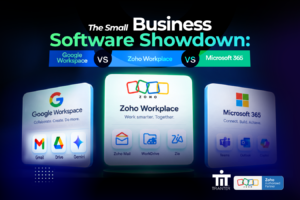
Zoho Workplace includes business email, chat, video meetings, calendars, documents, spreadsheets, presentations, and file management. Its return is broad rather than dramatic. It reduces tool sprawl and gives a young company a professional communication foundation. Independent research that isolates the return on a collaboration suite is thin, so the case here rests on practical savings, such as replacing several separate subscriptions, rather than on a published statistic.
The return is high for four reasons. Professional email improves credibility. Shared documents reduce version control problems. Chat and meetings keep remote teams aligned. It can replace several separate subscriptions.
Start here if: You need a clean, affordable business communication stack from day one.
Recommended Adoption Order
Zoho CRM: more closed deals, best from the first customer or lead.
Zoho Books: better cash control, best from the first invoice or expense.
Zoho Projects: on time delivery, best once you have multiple clients or projects.
Zoho Desk: customer retention, best once support volume grows.
Zoho Campaigns: repeatable demand, best while you build an audience.
Zoho People: scalable human resources, best once you hire beyond the founders.
Zoho Analytics: better decisions, best once you have multiple data sources.
Zoho Workplace: team productivity, best from day one.
Workplace appears last in the ranking because its return is the hardest to measure, but in practice many startups set it up first because it provides the email address and documents that every other tool depends on.
A Practical Startup Stack
For most early stage startups, the strongest starting combination is Zoho CRM, Zoho Books, and Zoho Desk. Together they cover the three things that determine survival: winning revenue, managing money, and customer satisfaction. As the business matures, add Zoho Project for delivering work, Zoho Campaigns for marketing, Zoho People for human resources, and Zoho Analytics for decision making.
Zoho’s Startup Program
Zoho runs a startup program that offers wallet credits to eligible startups. Eligibility depends on factors such as your region, whether you are new to Zoho, and whether you are connected to one of Zoho’s partner incubators, and credits expire after a set period. Terms change over time, so check Zoho’s startup page for the current conditions that apply to a U.S. company before you plan around the credits.
Final Take
If you can choose only one Zoho app first, choose Zoho CRM, because no startup survives long without a reliable way to manage leads and customers. If you can choose two, add Zoho Books, because revenue means little if you cannot invoice, collect, and control expenses. The best Zoho stack is not the largest one. It is the smallest set of apps that removes your biggest current bottleneck.
Choose Tranter-IT to implement your Zoho solutions today. Visit: www.tranter-it.com/home-us